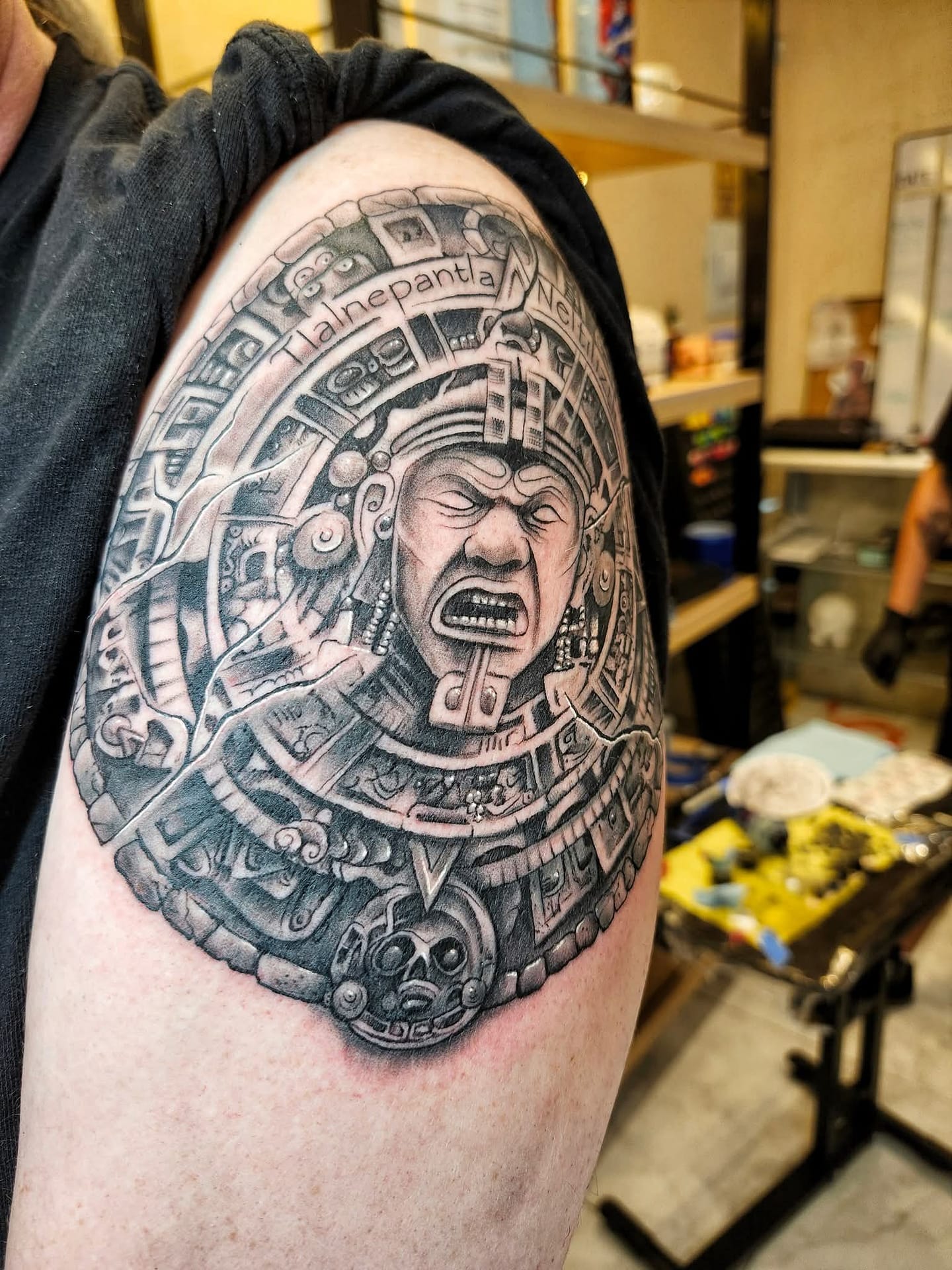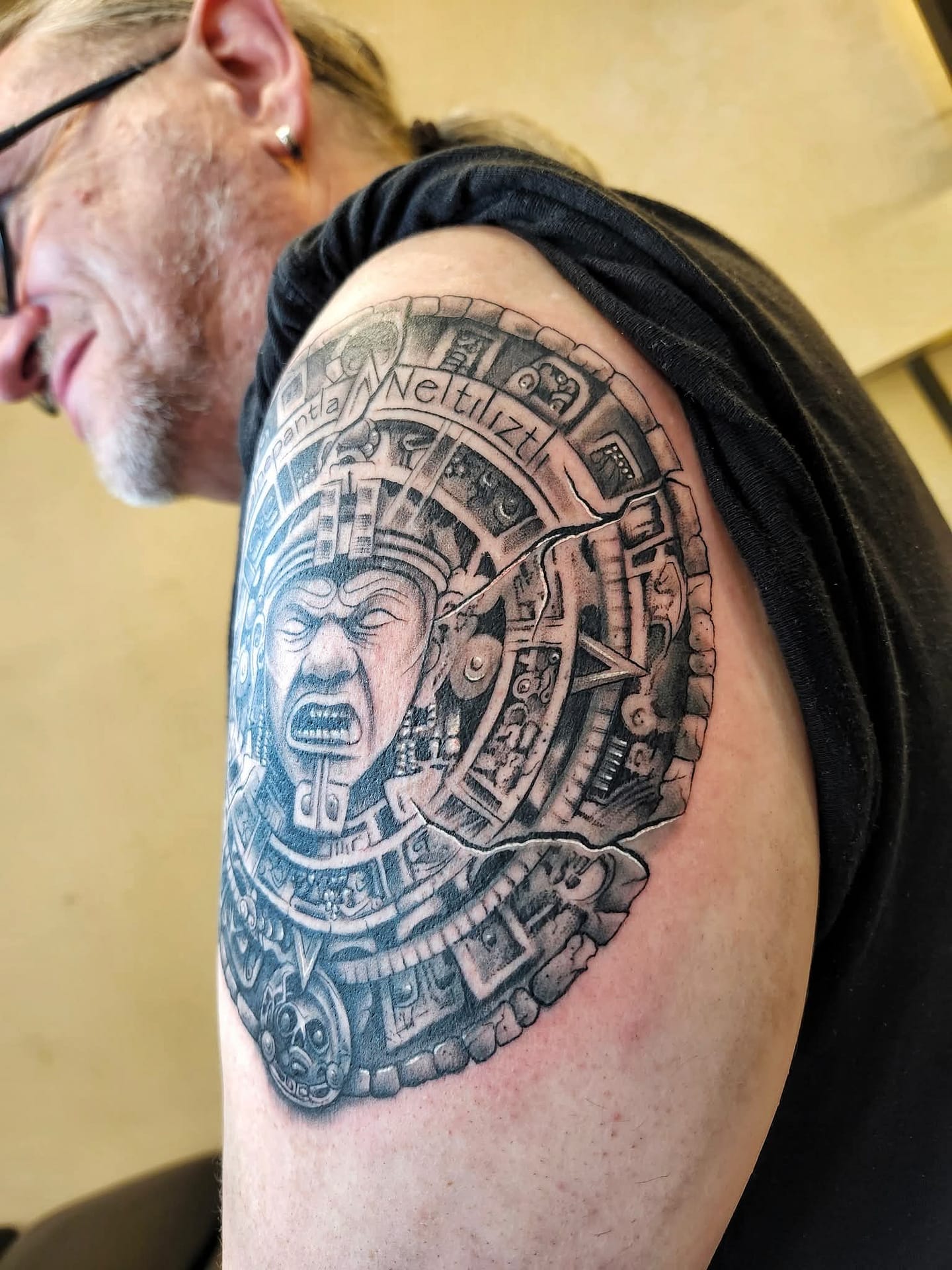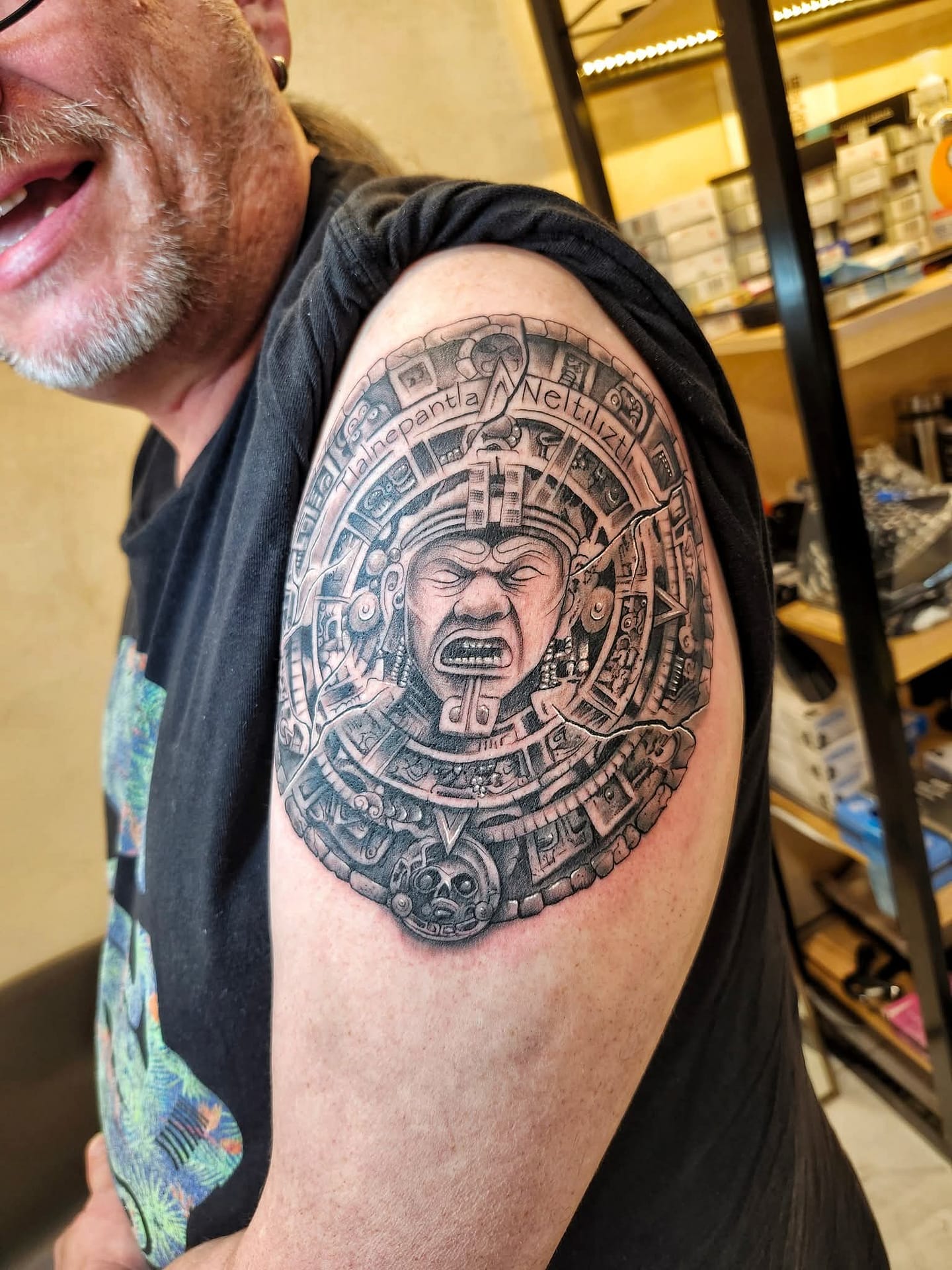
I recently got my first tattoo while travelling in Mexico. This was a big deal for me because I had waited for many years to get something that I felt passionate enough about to put in a tattoo.
If you know me, you will know that I read a lot and I love history and philosophy. Besides history i am an avid Sci-Fi reader because science fiction often delves into the human condition in situations that are either other worldly or set in the future.
Amber did a bunch of research before we went to Mexico about places to get tattoos because she wanted to get something she had been waiting to get for a while. (A tattoo of our beloved dog Stella who passed away last year at the age of 14 almost 15)
One of the the cultures that has always fascinated and interested me were the Aztecs. When I was very young I learned about the Aztec culture and over the years I’ve added to that knowledge. The philosphy of the Aztecs and how they viewed the world has similarities to several cultures around the globe and also align with my view of life. The tattoo i decided to get is a conceptual piece of art based on the Aztec sun calendar with Tonatiuh at the center who was considered the fifth sun.
The words I chose to put in the tattoo are “Neltilitzli” and “Tlanepantla” these are translated as “Truth” and “middle ground” or “middle way”.
Here’s a bit of a summary of Aztec philosophy.
Aztec philosophy was a pragmatic and process-oriented system focused on maintaining balance in a world perceived as inherently unstable and in constant motion. Central to this thought was the concept of teotl, a sacred, self-generating energy that permeated and constituted reality. A key ethical and practical question was how to live well on the “slippery earth” by balancing one’s life and actions, using concepts like discipline, durability, and drive to navigate the “middle way” (tlanepantla) between extremes.
Neltiliztli is an Aztec concept that translates to “well-rooted,” “true,” and “authentic” life. It refers to a philosophical goal of living a worthwhile, rooted life rather than one focused on mere happiness or external validation. This concept involves balancing oneself with the world and living with integrity, especially in the face of life’s uncertainty.
Core concepts:
The “slippery earth”: A central metaphor for the instability of life and the cosmos, emphasizing the constant need for balance and the potential for chaos.
Teotl: A pantheistic concept of a single, sacred, self-generating energy that is the source and substance of all reality. Reality is seen as this energy constantly unfolding and transforming.
Dialectical Monism: A view of the cosmos where opposing forces, like life and death, are not separate but interdependent and complementary aspects of the same single process.
The “middle way” (tlanepantla): The practical goal of life was to find the apt expression of action, choice, or feeling by staying in the middle, avoiding excess. This applied to everything from moral behavior to the choice of clothing.
*Wisdom and ethics: Philosophy was practical and aimed to provide answers to how to live a good life by maintaining personal and cosmic balance. Ethical values were rooted in community and fulfilling one’s obligations, a path to a more stable and meaningful existence.
Willpower: This was understood in three forms: drive, durability, and discipline, all necessary for navigating the challenges of life.
Practical application and wisdom
Education: Wisdom began with understanding one’s surroundings and relationships. Structured group discussions were common, and even children were taught discipline through practical tasks like sweeping and carrying logs.
Balance: The philosophy promoted a life of “rootedness,” emphasizing strong connections to family, community, and nature as a source of stability.
Ethical pessimism: Aztec thought acknowledged the fragility of life and the possibility of disillusionment. The goal wasn’t necessarily happiness, but rather living in a way that was stable and balanced, acknowledging the difficult nature of existence.
The Aztec sun calendar has too much woven into it to go into detail, but with he conceptual tattoo I wanted to encompass the Aztec philosophy and get something that looked really nice as well. A real piece of art that is beautiful to look at, captures the imagination and simply looks pretty cool!
I started with an art concept taken from the web and then worked with the tattoo artist to make it unique and add the elements i wanted included.
The pics are the result of this and i’m extremely pleased with how it turned out.
As we travel, travel through the world and life (you might say) I hope to draw from other native cultures including our own here in Canada and other places around the globe and add tattoos that reflect the life philosophies of the native cultures that help shape modern civilization and my own philosophical views on life.